Hot Water Slab Leak Repair in Missouri City, TX
When a hot water line ruptures under your concrete foundation, it creates heated floors, continuous gas or electric consumption, and rapid sub-slab erosion. Experience focused hot water slab leak repair Missouri City homeowners trust to eliminate energy waste and structural hazards.
Why Hot Water Supply Lines Fail First Beneath Missouri City Slabs
In residential foundations throughout Fort Bend County, hot water lines fail at significantly higher rates than cold water lines. Over eighty percent of supply-line sub-slab failures involve the hot water distribution circuit. The primary reason is thermal expansion and contraction. Each time hot water is drawn for showers, dishwashing, or laundry, the copper pipe heats up to 120-140 degrees Fahrenheit, physically expanding in length. When flow ceases, the pipe cools and shrinks back to ambient slab temperature.
Over thousands of heating and cooling cycles, this constant physical elongation causes the copper pipe to rub against surrounding concrete, rough aggregate, and crushed rock backfill. The abrasive friction wears down outer copper pipe walls, producing micro-fractures and pinhole leaks. Combined with corrosive local water chemistry and soil friction caused by shifting gumbo clay, this dynamic makes a hot water line leak under slab Missouri City homes an urgent structural issue requiring dedicated slab leak repair in Missouri City.
Common Symptoms of a Hot Water Slab Rupture
Unlike cold water leaks that may hide silently beneath slabs, hot water line failures manifest distinct thermal and mechanical red flags:
- Noticeable Warm Spot on the Floor: A localized patch of hardwood, laminate, or tile feeling remarkably warm or hot to bare feet, often accompanied by flooring buckling or adhesive melting.
- Water Heater Running Constantly: You hear a water heater running constantly Missouri City homeowners notice burning gas or drawing continuous electrical power even when no taps are in use.
- Sudden Spike in Utility Bills: A dramatic, inexplicable jump in your monthly natural gas bill or electric bill alongside climbing municipal water charges.
- Reduced Hot Water Pressure and Capacity: Running out of hot water rapidly during morning showers because gallons of heated water escape underground uninterrupted.
- Damp Baseboards and Mildew Odor: Elevated indoor relative humidity, musty smells radiating from baseboards, or peeling wall paint near bathroom walls.
Floor Feeling Unusually Warm?
Don't let gallons of heated water erode your foundation and inflate energy bills. Contact an experienced local specialist right now.
Call (888) 205-7875Locating Hot-Water Slab Leaks With Advanced Thermal Imaging
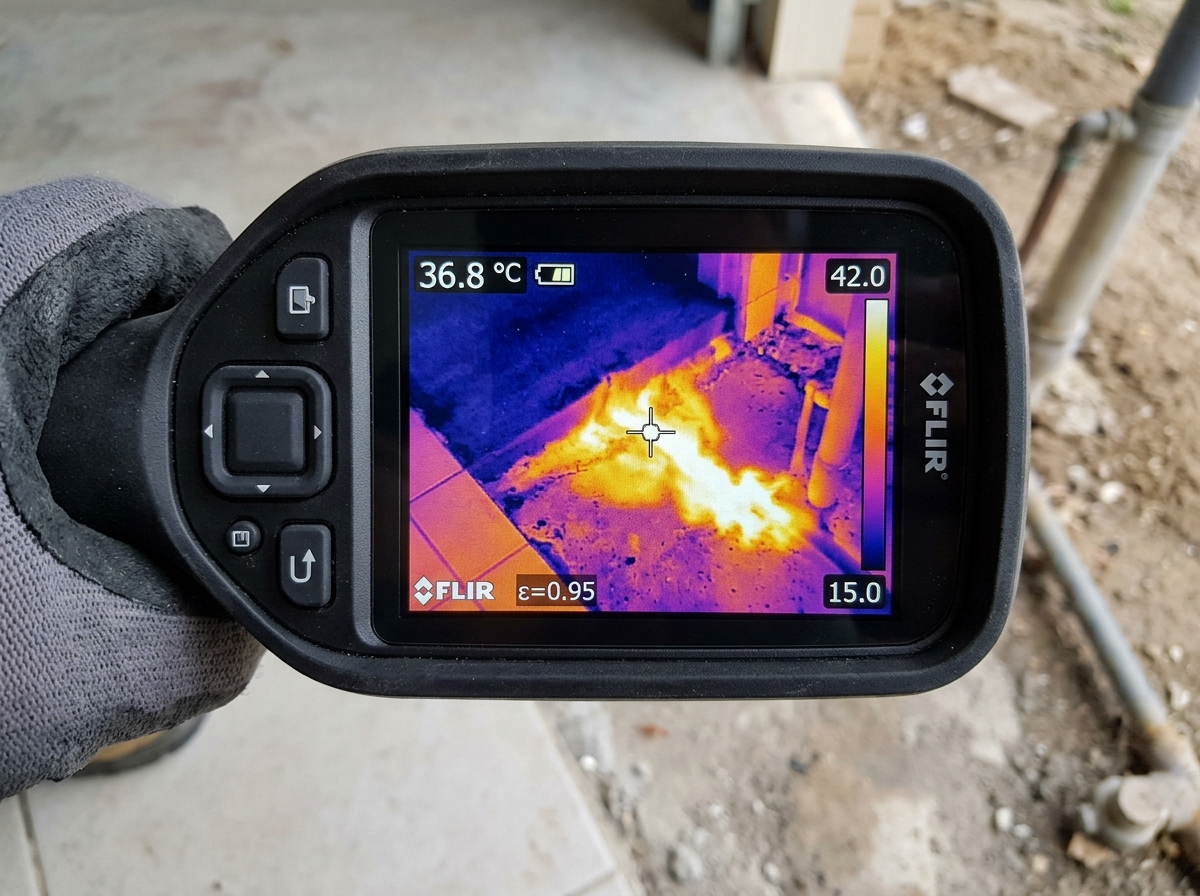
Because hot water transfers heat directly into the dense concrete slab structure, specialized forward-looking infrared (FLIR) radiometric cameras provide extraordinary diagnostic precision. During our comprehensive slab leak detection process, infrared cameras capture subterranean heat radiation mapping exact thermal plumes beneath the floor.
The hottest focal point corresponds directly with the underground pipe breach. Combined with electronic acoustic ground microphones that listen to high-frequency escaping water sounds, technicians verify the leak coordinates with surgical accuracy, avoiding indiscriminate concrete excavation.
Restoration Approaches: Spot Repair vs. Overhead Hot-Line Reroute
Once the ruptured hot water line is located, homeowners must evaluate whether to perform a localized spot repair or execute an overhead hot-line bypass:
When a Spot Repair Makes Sense
A direct spot repair involves opening a localized portion of the concrete floor to expose the leaking copper pipe, cutting out the damaged section, and brazing in a new piece of hard-drawn type L or type K copper. Spot repairs are typically recommended only when:
- The failure occurs in an easily accessible utility area, unfinished garage, or closet.
- The surrounding copper pipe shows thick, healthy wall dimensions with zero signs of extensive pitting.
- Flooring replacement costs in the affected area are negligible.
Why an Overhead Reroute Is the Superior Long-Term Solution
In most vintage Missouri City homes, an underground hot water line that has failed once is already corroded along its entire subterranean length. Performing an overhead slab leak reroute eliminates future sub-slab vulnerability permanently:
- Zero Floor Demolition: Preserves expensive hardwood flooring, designer tiles, and custom carpet by leaving the slab intact.
- Continuous High-Grade PEX Tubing: Technicians run durable cross-linked polyethylene (PEX) through wall cavities and attic spaces directly from the water heater manifold to the fixtures.
- Protection From Slab Stress: Overhead lines are completely isolated from shifting gumbo clay foundation movement and underground moisture erosion.
Managing Water Heater Strain and Post-Leak Equipment Care
A continuous subterranean hot water leak places extraordinary strain on your water heating equipment. Gas burners firing nonstop or electric elements operating 24 hours a day accumulate severe mineral scaling, tank sediment, and premature thermostat degradation. Following leak repair, technicians evaluate your water heater to ensure heating elements, pressure relief valves, and tank integrity remain safe and efficient.
Stop Hot Water Waste Under Your Slab
Call (888) 205-7875 now to speak with a technician and schedule prompt thermal detection and hot water line repair in Missouri City.
Call (888) 205-7875